The manta ray is one of the most graceful animals in the sea, with a wingspan that can pass seven meters yet a diet of nothing but plankton. It has the largest brain of any fish and shows striking curiosity toward divers. Watching a manta barrel-roll through a cloud of plankton is one of diving's great spectacles. Some individuals appear to recognize familiar dive sites and return to the same cleaning stations year after year. Like the whale shark, it proves that giants can be gentle, and that the ocean rewards divers who move slowly and watch with patience.
How to recognize it
Look for two enormous, triangular wings, a black back and a white belly, and two fleshy lobes that unroll in front of the mouth to funnel in plankton. The underside carries a unique pattern of dark spots.
Do not confuse it with a stingray. Mantas have no stinging barb at all and swim high in the water column rather than resting on the bottom.
Behavior
Mantas feed by swimming with the mouth open, often doing repeated backward somersaults through dense plankton to keep eating in the same rich patch. They also visit cleaning stations where small fish pick parasites off their skin, returning so reliably that some stations become lifelong meeting points.
They are famously curious and will sometimes circle divers again and again, seemingly as interested in us as we are in them.
Where it lives
Manta rays live in warm and temperate oceans worldwide, gathering at reefs, seamounts and cleaning stations where currents concentrate their food. Reef mantas stay near coasts while oceanic mantas roam the open sea.
They are not a typical sight on Colombia's continental Caribbean reefs, which are better known for eagle rays and turtles.
Conservation
Mantas are classified as Vulnerable. They reproduce very slowly, giving birth to a single pup every few years, so populations recover slowly from fishing and bycatch.
Marine protected areas and responsible diving, keeping low, breathing calmly and never chasing, are key to giving these acrobats space.
A diver's note from Isla Fuerte
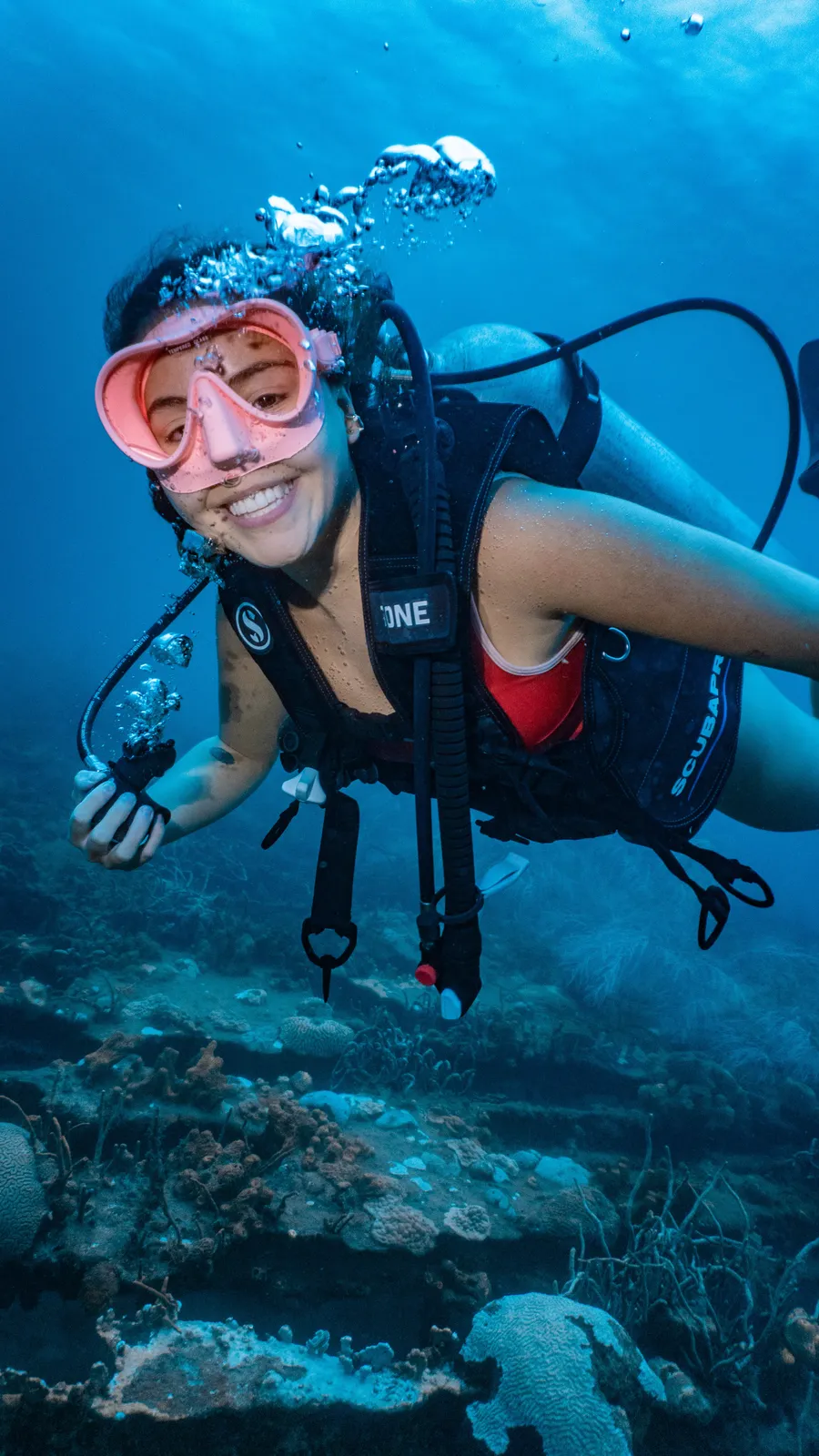
Mantas may headline distant destinations, but the sense of flight underwater begins wherever you learn to glide with good buoyancy. In Isla Fuerte you can master that skill in warm 27 to 29 degree water and then meet our own soaring wonder, the spotted eagle ray that inspired the Nautilus logo.
The same wonder is closer than you think. Explore our experiences and start your journey in the Colombian Caribbean.